


You probably know about Avatar: the film about blue people* that’s also the highest-grossing film of all time. But you may not know that the majority of Avatar’s $2.9 billion earnings came from 3D screenings.
This was in 2009, and as you can probably imagine, such mind-boggling figures led to something of a 3D renaissance in the film industry. In 2008, the percentage of UK box office sales generated through 3D films was around 2%. By the end of 2010, that figure had skyrocketed to almost 30%.
However, that turned out to be the peak of 3D film. By 2017, it was once again making up less than 5% of box office revenue in the UK.
So how did 3D film go from spearheading the highest-grossing movie of all time to a forgotten relic? This is the rise and fall of 3D film.
*I’m also available for film reviews.
The first thing to say about the rise and fall of 3D film is: which one? Because this Avatar-inspired boom wasn’t the first time that 3D cinema has gotten big.
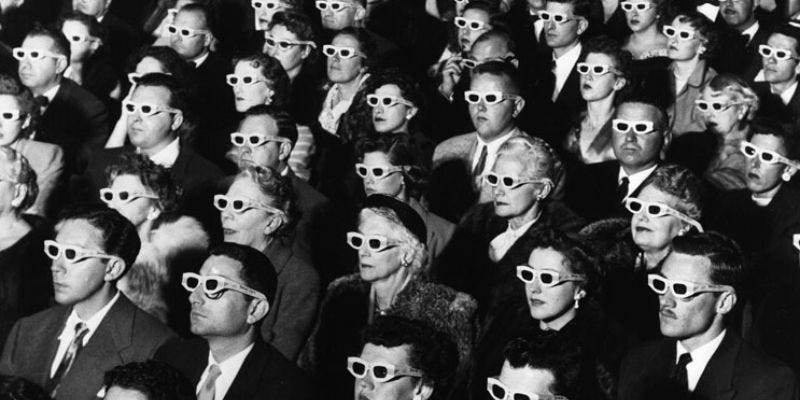
The first 3D wave came all the way back in the 1950s, at a time when those Hollywood execs were worrying once again. This time they were concerned that the explosion of the home television would reduce box office takings at the cinema - which to be fair, was completely justified. In the US in 1946, cinema attendances peaked at an extraordinary 4.7 billion. That figure had plummeted to 2.8 billion by 1952.
So when 3D came along, it was perfect. People couldn’t watch 3D shows at home, so it was something totally unique that cinemas could use to attract the TV generation. The first big 3D film of this era was 1952’s Bwana Devil, which I haven’t seen but am nonetheless confident is absolutely terrible. It’s about a team of colonial-era railway-builders in British East Africa who kill a bunch of man-eating lions.
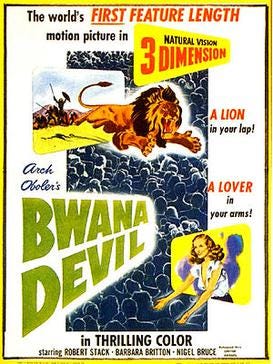
The snooty film critics weren’t impressed - Hollis Alpert said ‘it is the worst movie in my rather faltering memory’ - but what do they know? The film was a box office smash, grossing $2.7 million in the US and Canada alone. That’s about $32.5 million in today’s money. 3D was here to stay!
And for a while at least, it seemed like that might be the case. The next few years saw a flurry of 3D films, though none can be said to have really stood the test of time - apart from one, that is. Alfred Hitchcock’s Dial M for Murder was originally intended to be shown in 3D, but ended up being displayed in 2D in most cinemas. The reasons for this illustrate the reasons behind 3D film’s first fall.
Firstly, projecting a 3D film back in 1953 took a hell of a lot of effort. They required two sets of film to be projected simultaneously, which was very difficult to get right. If the two prints were even slightly out of sync, the film would become unwatchable and actually quite painful - headaches and eyestrains were a common symptom of an out-of-sync 3D film. This also required two projectionists to be working at the same time.
Because you needed so many reels of film to be able to show a 3D movie, it meant that most feature-length films required a short intermission to allow for extra film to be loaded into the projector. Given that a film like Bwana Devil had a running time of just 79 minutes, it’s easy to see how these intermissions could get quite annoying quite quickly.
Then there was the issue of the glasses. They were uncomfortable, especially if you already had to wear glasses. They could lead to headaches and even motion sickness in some. They dulled the vibrant colours of films, reducing them down to a sepia-tinged freeze frame. Oh, and they also looked ridiculous.
Despite these issues, 3D films continued to be released fairly prolifically up until 1954. Then there was a dramatic drop-off. Forty-six 3D films were released that year. In 1956, just two 3D films hit the big screen. Looks like 3D film wasn’t here to stay after all.
Though 3D films did see another brief renaissance in the 1980s - the first time since the 50s that more than 10 made it to cinemas in a calendar year - it never reached the same peaks that we saw in the 50s. Until 2009, that is.
It’s not outrageous to say that the most recent rise of 3D films was down to one man, and one man alone: James Cameron. The Avatar director was an early and passionate advocate of 3D, and Avatar was one of the first 3D films that made the most of the technology’s possibilities. It was filmed using a 3D camera and the movie’s CGI was also done in 3D, unlike many films which tacked on 3D effects in post-production.
Plus, it probably helped that a lot of cinemas had to screen it in 3D or else they wouldn’t be able to screen it at all (out of the 3,457 theatres that showed it in the US, 2,032 showed it in 3D). According to one Redditor, “I work at a movie theater, and per Cameron’s request (literally, that’s what the company-wide email says), approx. 75% of showtimes have to be in 3D, which includes every IMAX showtime. I’d imagine other national chains were given the same direction.”
It seemed that Cameron’s deity-like worship of 3D was getting film fans excited: more than 90% of advance ticket sales for Avatar were for 3D screenings. Again, the economics of the format helped. 3D films took more resources to screen and were a unique experience for cinemagoers, which meant cinemas could justify charging more money to see them. And at first, cinemagoers were largely happy to pay the premium. Around $1.7 billion of Avatar’s colossal $2.9 billion takings were from 3D screenings. Was 3D…here to stay?
Initially, it looked like it would be. Hollywood execs, recognising another opportunity, suddenly released almost every film in 3D. And they fared well. Shrek Forever After took 60% of its opening weekend sales from 3D screenings. Clash of the Titans took 55% of its total revenue from 3D screenings. Alice in Wonderland’s proportion of 3D revenue was 70%.
In fact, the glut of 3D releases that year was even causing traffic jams in cinemas. “For a while, Hollywood was hanging back to see what would happen and whether 3D would catch on,” said entertainment journalist Kim Masters in 2010. “Then Avatar happened, and now everyone’s scrambling to make sure their popcorn movies can be seen in 3D. So along comes How to Train Your Dragon this Friday, and Warner Bros. is coming in with Clash of the Titans next week, there’s still Alice In Wonderland - and Avatar is still playing on some 3D screens. So there is in fact a traffic jam.”
“[3D film] will in fact become the standard, and pretty soon we’ll even be watching 3D movies at home”
Kim Masters, entertainment journalist
This backlog of films was even leading to Godfather-style threats from competing families production companies. “Paramount Pictures is telling theaters that if they don’t show the upcoming DreamWorks-produced Dragon on a 3D screen, then it will withhold from the theater a 2D version of the movie to play instead,” reads a 2010 Washington Post report.
“If you have one 3D screen available and you don’t play Dragon, they’re not going to give you the version in 2D,” one California theater operator reportedly said. “It’s an underhanded threat.”
These 3D films weren’t just causing headaches for cinemagoers - cinemas were suffering too. Though 3D technology had come on considerably since that film about man-eating lions**, it still faced similar issues to before. Cinema screens had to be modified in order to be able to show 3D films, and there simply weren’t enough to keep up with demand. In 2010 it was estimated that there were around 3,500 3D screens in the United States and Canada; less than 10% of the total number of screens. “That’s not enough to accommodate two 3D movies at the same time, let alone three,” reckoned the Los Angeles Times.
Traffic issues aside, 2010 still turned out to be 3D film’s golden year. It accounted for 22% of box office revenue in the US & Canada (which equated to $2.2 billion), and 28% in the UK. Of the top 10 grossing films in 2010, six of them were available in 3D. It really, genuinely looked like 3D was here to stay.
“We are well beyond fad phase,” declared Masters at the start of 2010. “There are people - including me - who think that this will in fact become the standard, and pretty soon we’ll even be watching 3D movies at home.”
However, dig a little deeper beneath the surface, and the warning signs were there for all to see.
**just reiterating again that I’m available for film reviews.
Though 2010 saw a glut of high-grossing 3D films, only Avatar (and arguably Dragon) had really wowed audiences. In many more, the 3D element had felt tacked on or unnecessary.
For example, Clash of the Titans had pocketed tens of millions from 3D screenings, but was initially only supposed to be shown in 2D - it was hastily converted to 3D to capitalise on Avatar’s success. However, it was widely panned by fans and critics alike. A film reviewer from the Chicago Times reckoned the film was actually worse in 3D, whilst in 2013, the film’s director (yes, the director) called the 3D conversion ‘rushed and horrible’ and ‘a gimmick to steal money from the audience.’ Ouch.
The Clash of the Titans fiasco knocked the public’s confidence in 3D films. Where Avatar had broken down barriers and created a genuinely stunning movie, the flood of bolted-on films that followed in its wake seriously damaged the reputation of 3D movies. Gulliver’s Travels, The Last Airbender and Mars Needs Moms were all either expensive flops or criticised by critics.
There was also the cost element. Studio execs reckoned it cost an extra $10 million to shoot a film in 3D, making it vital to recoup those extra dollars in cinemas. And so if a film didn’t get at least 50% of its revenue from 3D screenings, it was going to struggle. In 2011, that started to happen regularly. None of the 3D films released in 2011 hit that magical 50% mark. In the first half of 2011, 3D revenues fell by 21% in the UK. Over the course of the year, 3D revenues in the US and Canada fell by $400m to $1.8 billion.
Still the industry insisted that all was well despite all the evidence to the contrary. “It’s institutionalised now,” said Brandon Gray, founder of film-industry website Box Office Mojo in 2011. “There’s no going back.”
It turns out there was a going back. 3D films gradually became rarer and rarer, and revenues started getting smaller and smaller. By 2017, 3D takings in the US and Canada had plummeted to $1.3 billion. In the UK, they had gone from a 30% market share to a 5% market share. That market share has only continued to shrink.
“It was a game-changing opportunity for the industry. But we blew it.”
Jeffrey Katzenberg, movie executive and producer
It’s not that 3D films have disappeared entirely. James Cameron has continued his one-man mission to boost 3D film-making with the release of the two subsequent Avatar sequels. Other, isolated examples have shown off the possibilities of the technology.
But the same problems that were there 70 years ago remain today. 3D rarely adds anything extra to a film, and even if it does, it’s rarely enough to justify the elevated ticket price. The 3D glasses remain clunky and uncomfortable. They can still give you headaches and eye strain. It remains expensive to make and screen 3D films - often prohibitively so.
What’s more, other technologies have now appeared. For example, 4DX is a kind of sensory film experience where your seat sways and special effects are sprayed at you from the seat in front. And maybe worst of all for those Hollywood execs, 3D is no longer exclusive to the cinema. With the rise of VR headsets, you can now just as easily watch a 3D film at home.
While you should never say never, 3D will never return to those heady heights of 2010. But during those golden years, it really felt like it was going to change the world.
“It was a game-changing opportunity for the industry,” says film producer Jeffrey Katzenberg. “But we blew it.”