


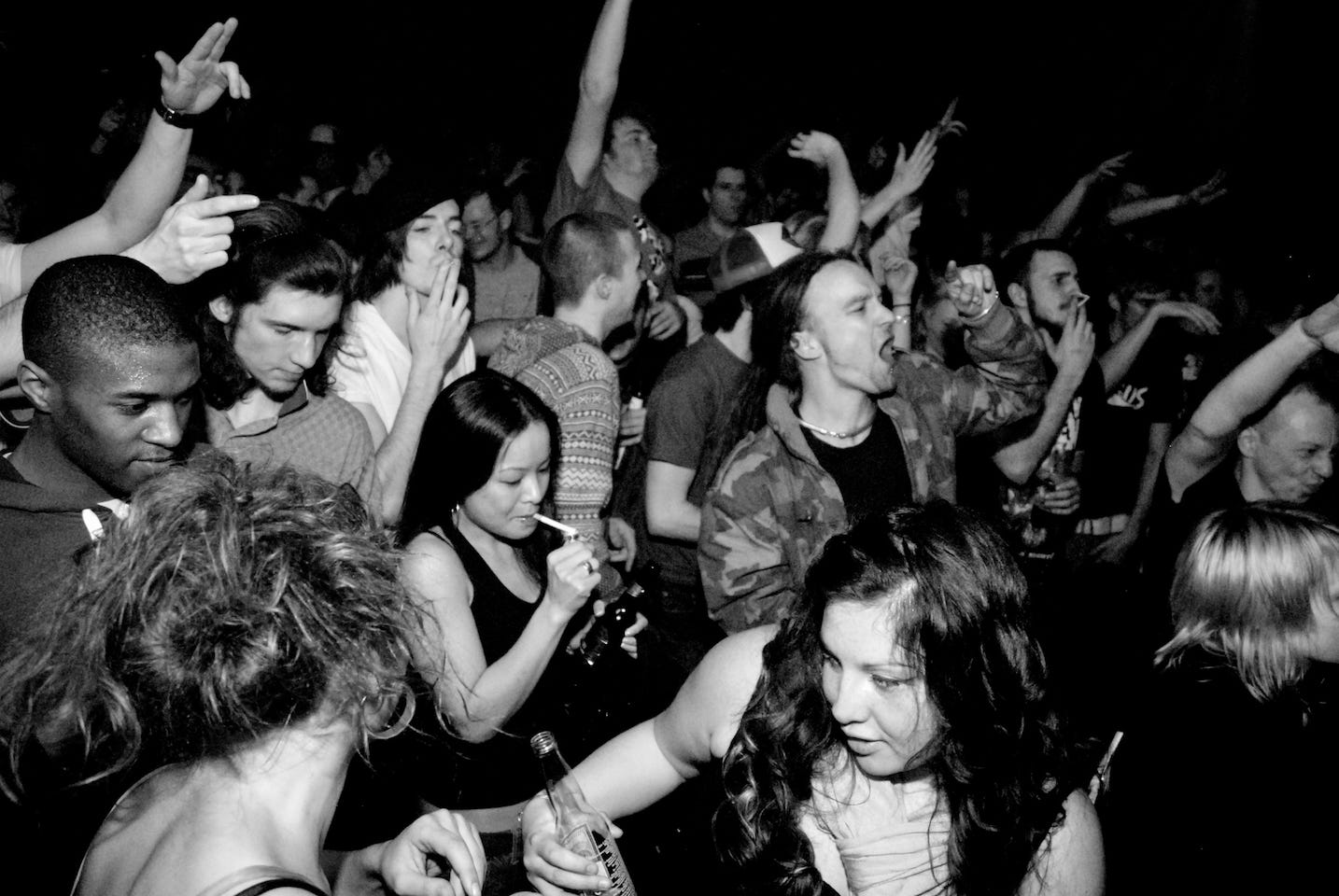
It’s about 3am on a freezing cold Tuesday night in October 2010, and Basement 45 in Bristol is shaking. Sweat is dripping from the ceiling and a vacant gaze is emanating from everyone’s eyeballs. They’re clustered around a DJ in a small cage who’s spinning a style of music that they’ve possibly never heard anything like before. It’s all heavy, distorted basslines, pulsating rhythms, menacing undertones and drops. Drop after drop after drop.
Welcome to the sound of dubstep.
For people of a certain age, dubstep played a huge role in their formative years. It was the soundtrack to their university days, their first visits to nightclubs, and their first experiences of taking drugs. And back in October 2010, it was inescapable. ‘Katy on a Mission’, sung by Katy B and produced by dubstep producer Benga, had just debuted at number 5 in the UK singles chart. The month prior, ‘I Need Air’ by Magnetic Man - composed of dubstep OGs Skream, Benga and Artwork - peaked at number 10. Dubstep nights were more common than foam parties.
Yet just a few years after these mephedrone-induced highs, dubstep seemed to have completely disappeared off the face of the earth. So what happened?
Croydon is an isolated and sometimes forgotten-about part of London that gives it a bit of an outsider’s feel; it’s more impervious to outside influences than other parts of the capital, and its mainly working-class population haven’t always shared in the riches of this rich city. But that geographic and financial isolation turned out to be the perfect melting pot for dubstep, inspiring the genre’s early producers to create a totally original style of music inspired by their surroundings.
Big Apple Records had been serving Croydon’s music community since 1992. It stocked records spanning jungle, garage, reggae, dub and 2-step alongside newer releases from the likes of Zed Bias and Oris Jay (aka Darqwan), who had both started experimenting with a wobbly, bass-heavy production style in the early 00s. This is best seen in tunes like Neighbourhood (2000) and As We Enta (2001). All of these sounds were pivotal influences on dubstep’s early pioneers.
Those pioneers included local producer Artwork, who had a studio above the Big Apple shop floor. He decided to launch a record label to start putting out his releases - starting with the Red EP in 2002 - which were influenced by the sounds he heard at Big Apple. He also decided that they would be exclusively available from the shop downstairs. To help achieve his vision, Artwork hired fellow local DJs Hatcha and Hijak to run the shop and launch the label.
The first releases on Big Apple Records from Artwork, fellow Croydonite Benga and Hijak’s brother Skream started to bring together a sound that had been bubbling in London’s underground for years. Though dubstep eventually became harsh and high-tempo club music, these early dubstep releases were all about heavy, distorted basslines, shuffling 2-step rhythms, and a lingering air of menace. They took more influence from dub than any other style of music.
A growing cluster of DJs and producers around Big Apple were also starting to make their mark on this emerging new style. Regular visitors to the shop included Loefah, Mala and Coki, who in 2004 founded the record label DMZ to start putting out their own releases. In March 2005 they founded the DMZ clubnight, which together with Rinse FM’s FWD>> would become an early epicentre of the dubstep movement.
Still, at this point in the story there was little more to dubstep than the people who were making it.
“We used to go there (FWD>>) and there was probably 50 people in the whole club, and 35 of those were producers,” Artwork recalled in 2015. “So you’d make your music and then you’d go there to hear your records being played.”
Even if dubstep remained firmly underground, these clubnights were providing an important incubation space for its main players. And there were signs that the mainstream was starting to take notice. In 2004, listeners of John Peel’s Radio 1 show voted for their top 50 tracks of the year. Included in the 2004 list were tracks by Digital Mystikz (a duo comprising Mala and Coki) along with fellow dubstep producers Plastician and Distance.
But another Radio 1 DJ, Mary-Anne Hobbs, would give dubstep its biggest leg-up yet in January 2006. Dubstep Warz was a two-hour long showcase of the exciting new genre and its biggest producers. They included Digital Mystikz, Skream, Loefah and Mala - all of whom had sprouted from Big Apple Records. Burial also featured on that broadcast, and his debut album in May 2006 became a seminal dubstep release.
Dubstep was getting bigger by the day. Having been sparsely attended just six months earlier, DMZ’s first birthday party in March 2006 had a queue of 600 people locked out of the 400-capacity venue. Then, in June 2007, Mary Anne Hobbs presented a special dubstep showcase at the influential electronic music festival Sonar, in Barcelona. But dubstep’s true breakout moment was just around the corner.
Caspa and Rusko were on their way back from a Halloween set in Sheffield in 2007 when they got a call from fabric Records. The story goes that French electro duo Justice had submitted the latest mix in the FABRICLIVE series, but it had been rejected by label bosses. With the deadline looming in a few days, the two dubstep producers were asked to quickly put a mix together instead. It would be the first dubstep-focused release in the series.
This was a massive opportunity for the pair. FABRICLIVE was a hugely influential set of releases that showcased the brightest producers in electronic music. Basically, a slot in the FABRICLIVE series was the equivalent of a positive review in 1960s Rolling Stone or 2000s Pitchfork. It could make or break your career.
The resulting album, FabricLive.37, is commonly acknowledged as a game-changer for dubstep, and according to UKF, the 12th best-selling compilation from Fabric’s 200-strong discography. Not bad for something that was put together with a few days’ notice.
“We thought it might get us a few more gigs, that’s it!” recalled Rusko in 2017. “Suddenly we’re in this studio with a list of interviews from every corner of the world. We had to stop between calls to work out how to pronounce the station names because Gary kept getting them wrong. But yeah, we kinda started thinking: ‘okay, this is a bit mental…”
According to Caspa, everyone wanted to know about dubstep on the back of the mix. “Everything that had been bubbling for years before was coming to a head. We had The Guardian, Vice, even the fucking Sun all wanting to talk about it. Magazines, radio shows, newspapers from all over the world; Japan, Germany, Brazil, Romania. Everywhere. This changed everything.”
All of a sudden, dubstep had gone global - and the two young producers were the poster boys for the scene. But not everybody in the scene was happy about it.
“To be honest I think there was a bit of tension and bitterness from some members of the scene because of that,” Caspa said in that same UKF interview. “I don’t think it’s looked upon like this anymore but there was a feeling that the first mix of this level should have been taken care of in different hands.”
Loefah said in 2015 that several dubstep producers had already turned down FABRICLIVE - a claim that was echoed by Sgt Pokes. But it wasn’t just a case of sour grapes that Caspa and Rusko beat the scene to the punch. Their brand of dubstep was very different from the Croydon original: harsher, louder, and more aggressive. This wasn’t the version of dubstep that the originators wanted to broadcast to the world.
But this harsher sound went hand-in-hand with club culture and, increasingly, drug culture. After the seizure of 33 tonnes of sassafras oil in Cambodia in June 2008, pure MDMA was suddenly very hard to come across in the UK. It led to the rise of alternatives such as mephedrone - otherwise known as mcat - which contained almost no MDMA and could be bought legally online for a fraction of the price. Now, legions of young clubbers across the UK were being simultaneously exposed to high-tempo dubstep and high-potency mcat. It’s another reason why dubstep began to mutate into a more adrenaline-fuelled, aggressive, quicker sound.
Between 2008 and 2010, dubstep’s sound would continue to evolve as its popularity exploded. In one direction, those harsh edges were being sanded off in favour of a softer, more chart-friendly sound. A Skream song was featured on the influential UK youth drama Skins, before the same artist was asked to remix La Roux’s single ‘In for the Kill.’ It reached number two in the UK charts. There would be more chart success for dubstep in 2010 via the likes of Katy B and Magnetic Man (a dubstep supergroup comprising Skream, Benga and Artwork).
Then, at the end of 2010, dubstep’s biggest and arguably most controversial producer took the genre in another new direction. For some people, it marked the beginning of the end for dubstep.
If you’ve heard of dubstep, you’ve probably heard of Skrillex. His 2010 EP Scary Monsters And Nice Sprites took the harsher sounds of dubstep - which was already being made by the likes of Flux Pavilion and Rusko - and pushed them into even deeper territory. The drops are almost comically big, the basslines are distorted to breaking point, and the whole sound is so abrasive that it can be a challenge to listen to.
It may be a long way from the dub and 2-step records that the genre was born from, but it was this more aggressive package of dubstep that travelled the most distance. Skrillex became an electronic music superstar on the back of Scary Monsters and then 2011’s Bangarang, headlining festivals all over the world and producing for the likes of Justin Bieber, Beyoncé and The Weeknd.
Similar success followed for other high-octane acts such as DJ Fresh, who scored dubstep’s first ever number one in July 2011 with ‘Louder.’ At this point, it felt like dubstep was unstoppable. But you could argue that this was dubstep’s commercial peak. From 2011 the genre increasingly started to splinter in different directions, and its appeal waned.
Skrillex and his cohort went even bigger and even louder, taking the sound into what was later termed ‘brostep’ due to its popularity with EDM-loving Americans. The likes of Mount Kimbie and James Blake took dubstep and turned it into a softer, more soulful sound that was often called ‘post-dubstep.’ Drum and bass also started to replace dubstep at the top of the charts through acts like Chase and Status, Nero and Rudimental. As we moved through the 2010s, it felt like the public’s tastes were shifting.
And as dubstep moved further away from its original sound, its biggest names started to distance themselves from the movement.
“We didn’t give a shit about what was going on with dubstep at the time (in 2011),” Artwork later told VICE. “The sound had turned into a lowest common denominator race for loudness, and we just wanted to write songs for the radio [as part of Magnetic Man].”
Fellow Magnetic Man member Benga also started to distance himself from dubstep in 2012, telling the NME that he ‘doesn’t want to be any part of dubstep anymore.’ He later clarified those comments in an interview with CLASH, saying he hasn’t ‘completely stopped’ working on dubstep, but has instead ‘moved to other areas.’
Another of dubstep’s original pioneers was also moving on. After dabbling with house-inspired sounds for a period, in 2013 Skream announced that he would only be playing techno, house or disco at all future shows (though he has since started playing dedicated dubstep sets again).
Meanwhile, dubstep superstar Skrillex was also moving his sound more firmly into EDM territory - a shift solidified when he formed Jack Ü with Diplo in 2015.
With the genre’s biggest names out of the game, by the middle of the decade dubstep had become a rare sight at festivals, clubnights and the charts.
Dubstep reached its commercial peak in the early 2010s, but many would argue that the genre never ‘died’ as such. It simply morphed and evolved into different strands.
The genre’s pioneers - such as Skream, Benga and Artwork - started exploring new sounds not long after dubstep exploded. The likes of SBTRKT and Jamie xx incorporated dubstep influences into their work and became huge in the process. And the public’s tastes also moved on, with dubstep’s commercial crowd following Skrillex into EDM territory.
Ultimately however, a style of music born underground was never going to be totally comfortable at the top of the charts.
Dubstep nights like the one at Basement 45 are still a thing, though they’ve retreated to the underground rather than the cavernous clubs and festival fields they once filled.
For a genre that was born in smoke-filled clubs, it seems fitting that that’s where it has once again found its home.