


One of my earliest memories of listening to music is a far-too-young me, sitting in front of my CD player, listening to ‘clean’ versions of Jay-Z, Dr. Dre and Snoop Dogg albums (my mum wouldn’t let me get the explicit versions). And one thing that often stuck out on those records were the weird little spoken interludes between songs, otherwise known as skits.
Skits often took the form of things like studio chit-chat, spoof game shows or the recreation of old movie clips. And they’re the marmite of the hip-hop world. For some people, they added a humorous edge to a dark album or gave you a glimpse into the artist’s world. For others they were an irritant; an unnecessary and unskippable addition to an already-bloated record.
Whatever your point of view, at one point skits featured on the albums of pretty much every major rapper. So what happened to them?
The lineage of hip-hop skits isn’t immediately clear. A 2016 article from Audible points out the skit’s connections to the tradition of African-American oral storytelling, ‘one that included ghost stories, tall tales, sermons, and performative toasts.’ Meanwhile, a piece by Red Bull Music Academy the previous year points out their similarities with Richard Pryor’s comedy albums in the 1970s and 1980s, which used many elements we’d later see in skits: character work, improvisation, profanity, social commentary, and unvarnished street stories.
Whether any of those things were on the mind of producer Prince Paul in 1988 is unclear. What is clear that his decision to include a repeating game show skit in De La Soul’s 1989 masterpiece 3 Feet High & Rising was revolutionary. It’s generally considered to be the first example of a skit in a hip-hop album, and would inspire legions of rappers to produce similar skits.
As Prince Paul says in his interview with Red Bull Music Academy, at the time he was looking for a way to tie up De La Soul’s 3 Feet High and Rising; give it an identity and a theme running through it. Skits were a way to connect a dozen seemingly unconnected songs.
“We sat around listening to the record and I realised that we needed something to link it together,” Paul recalled. “My problem with a lot of hip-hop albums back then was that most MCs didn’t know who they were. I started thinking about those old game show formats where the host would always introduce some guy who would be like, ‘I’m George and I like water skiing.’ It was geeky, but it gave people an instant sense of identity.”
In the spirit of Pryor’s live albums, the game show spoof that eventually appeared on 3 Feet High & Rising was improvised, invented on the hoof in the group’s Long Island studio. That sense of improv would turn out to be a crucial feature of album skits in the years to come - not that Paul ever thought it would influence anyone or anything.
“We did it to fill that void, to give our album some structure,” he says. “It was just something we tried out and it evolved. We never thought it would become a rap album staple.”
Though De La Soul’s effort was fairly funny, it’s difficult to say it added to the album in any major way. It was light-hearted and never intended to do much more - as Paul says - than to ‘fill the void’ between the album’s sprawling set of songs.
Skits didn’t exactly take off straight away. The following year, Digital Underground’s Sex Packets - released on the same label as 3 Feet High and Rising - integrated skits into a concept album about a pill that gave astronauts satisfying sexual experience (a concept that, mystifyingly, hasn’t been revisited since). And concept albums were the perfect vehicle for skits. That;s because they often required an extra little something to establish a more coherent narrative and build on the concept.
Sex Packets is a pretty good album with fairly funny skits, but again, at this point in the story everyone within it would probably have been shocked to learn the impact skits went on to have. Sex Packets and 3 Feet… were both considered alternative - very alternative compared to what had come before. The songs were goofy, the skits were goofy, and they didn’t (yet) offer mainstream appeal.
NWA were a different beast altogether. They were already huge stars after the success of their debut album Straight Outta Compton, and in 1990’s 100 Miles and Runnin’ they added a skit-like track to the end of the EP. It’s a far cry from Digital Underground or De La; ‘Kamurshol’ is part-hype track and part-shameless promotion of their new music. But it also shared many elements of the emerging skit subgenre. It was improvised, it was foul-mouthed, it was full of braggadocio - but it’s still difficult to say it was memorable or went on to be influential.
However, the idea of the skit was clearly catching on. And in the next few years, they would play a central role in two of the decade’s biggest releases.
The Chronic was the first solo offering from one of NWA’s founding members and primary producer Dr Dre. And left to his own devices, Dre made full use of skits. He parodied the game show format in ‘The $20 Sack Pyramid’, while ‘Deeez Nuuuts’ produced an all-time meme after Warren G signed off the prank phone call by shouting ‘DEEZ NUTS!’ A 15-year old using the pseudonym ‘Deez Nuts’ tried to run for President in 2016, and at one point he was polling at 10% before being barred from running because he didn’t meet the minimum age requirement (35 years) to serve as president if elected.
All that from a skit!
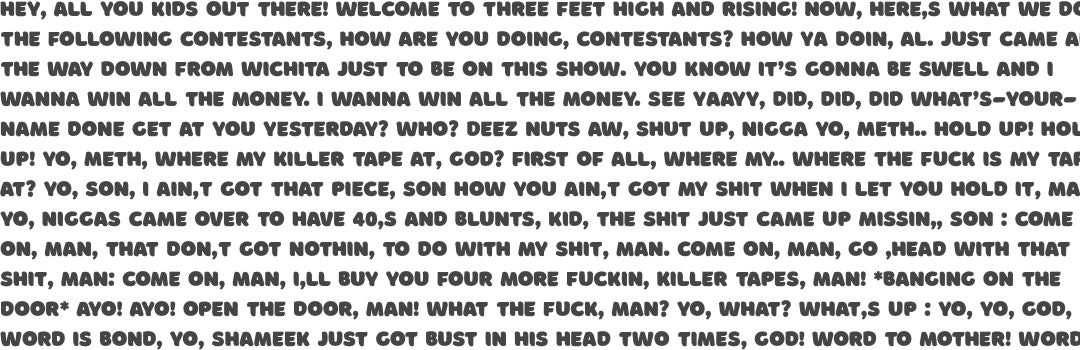
As silly as all that was, skits were starting to establish themselves in the hip-hop canon. The next major album to make full use of them was Wu-Tang Clan’s Enter the Wu-Tang (36 Chambers). Heavily inspired by kung-fu culture, the album’s many skits intersperse clips from their favourite kung-fu films with tales of New York street life. In the ‘7th Chamber’ skit, Raekwon is asking Method Man where his The Killer video tape is before being interrupted by Ghostface Killah with news of a shooting in the neighbourhood. ‘Intermission’ serves as a quick intro to the group’s many members and its ethos. Meanwhile, the intro to ‘Method Man’ captures comedic studio chat between Wu-Tang members about how they’ll ‘fuckin’ tie you to a fuckin’ bedpost with your ass cheeks spread out and shit’ and ‘lay your nuts on a fuckin’ dresser and bang them shits with a spiked fuckin’ bat.’
These skits added a cinematic dimension to the record while also giving the group’s nine members a clearer identity - which is exactly the same thing that Prince Paul was trying to do four years earlier. Skits were still scattered, chaotic and seemingly random, but certain threads like these were starting to run through them.
36 Chambers was huge, and its influence on hip-hop was massive. It triggered a wave of skits over the course of the 1990s, which can really be considered the golden age of hip-hop skits. The likes of Snoop Dogg, Eminem and Dr. Dre (again) all included skits within their records this decade, all of which sold in huge numbers. By the end of the decade they were everywhere. Mobb Deep went dark on his skits, Jay-Z reenacted famous movie moments, whilst Eminem used his skits to create characters and alter egos.
By this point, skits had come a long way from their simple origins. They were now being used to settle scores, break up long albums, inject humour into dark listens, and give the record’s creators a clearer identity.
At the same time, you can’t escape the fact that many of them were also quite annoying. Skits were often funny the first time you heard them, but didn’t exactly reward repeated listens. Most people would’ve skipped them if they could. The problem was, they often couldn’t. That’s because they emerged at a time when cassettes - though no longer the dominant form of listening to music - were still pretty popular. It was possible to skip skits on a tape player, but it was so cumbersome that most people didn’t bother.
That slowly started to change as CDs became the default format for buying and listening to music. Though CDs actually passed cassettes in total sales as early as 1991, tape sales didn’t really start plummeting until the mid-90s (their sales actually increased from 1993 to 1994). Around 350 million cassettes were sold in 1994, compared to 600 million CDs the same year. So although the balance was shifting in favour of CDs, tapes were still listened to by a decent proportion of the music-buying public.
It’s also worth pointing out that many rappers in the 90s grew up at a time when cassettes were dominant. They emerged from cassette culture, and so did many of their favourite artists. It maybe explains why hip-hop skits hung around even as cassette sales sharply declined in the second half of the 90s.
As the nineties turned into the noughties, there were still some popular albums released that made use of skits, with Outkast’s Stankonia and Kanye West’s The College Dropout probably the most notable. But they increasingly felt like a relic from a bygone era, done to fuel artist nostalgia rather than moving the genre forward in any way. And of course, with CDs now dominating, skits were much easier to skip. From an artist’s perspective, that often mean they simply weren’t worth the time to put together.
Today, with streaming being the dominant form of music consumption, hip-hop skits are even easier to skip. But that’s not their only issue. In her book ‘Mood Machine,’ journalist Liz Pelly argues that a lot of casual listeners now consume music based on things like mood or season rather than engaging with entire albums. You’ll still get the occasional artist who intersperses skits throughout their work - Kendrick Lamar is one notable example, and his skit-like interludes in To Pimp A Butterfly and DAMN really do add another layer to an already-engrossing listen. But the idea of listening to an album from start to finish isn’t as common as it once was.
Within the streaming landscape, it’s difficult to see how skits fit in. For some people, they are a unique and lovable relic from their younger days. For others, they’re annoying chit-chat between songs that never needed to exist. Skits will probably continue to divide opinion in this way. But they probably won’t be making a comeback anytime soon.